en
RF coaxial connectors are connectors used in the radio frequency range, primarily for connecting coaxial cables and RF equipment for signal transmission. They consist of a cylindrical plug and socket, where the plug can be inserted into the socket and locked by rotation to form a signal transmission path.
RF coaxial connectors have advantages such as low signal transmission loss, wide frequency range, good durability, and ease of installation and removal. They are widely used in fields such as radio broadcasting, television transmission, radar, and satellite communication. There are many types of RF coaxial connectors, classified by interface type, frequency range, usage, and other criteria, offering a variety of models and specifications to choose from.
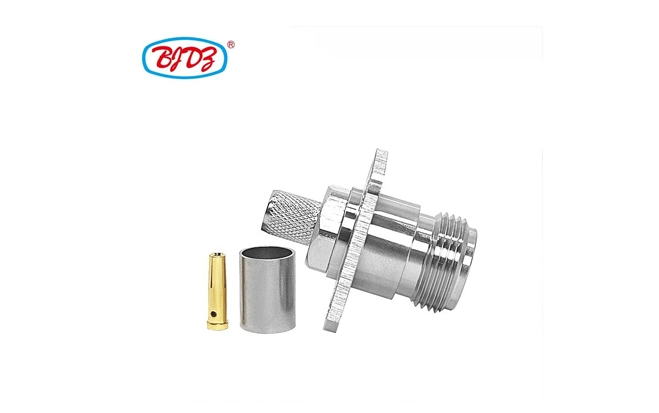
The structure of RF coaxial connectors typically includes the following parts:
Different types of RF coaxial connectors have different structural designs and connection methods, but the basic principles are similar.
The working principle of RF coaxial connectors is to establish a signal path within the connector, allowing the signal to be transmitted from one RF device along the coaxial cable to another RF device. The basic principle is to ensure that the mechanical connection and contact between the plug and socket allow the electromagnetic field between the two conductors to be continuously transmitted with minimal interference and loss.
In the connector, both the plug and socket contain a center conductor and a shell. The contact point between the center conductors is called the pin, and the contact point between the shells is called the barrier ring. When the plug is inserted into the socket, a seamless path is formed between the pin and the barrier ring, allowing the transmission of rich high-frequency signals. Additionally, components such as sealing gaskets, insulating sleeves, and metal retaining rings within the connector can provide waterproof, leak-proof, and anti-interference performance.
The performance of RF coaxial connectors is influenced by many factors, such as conductor material, contact pressure, contact conductive area, internal structure of the connector, and working environment. Therefore, they need to undergo thorough testing and calibration to ensure stable and reliable operation.
General specifications for RF coaxial connectors are established by organizations such as the International Electrotechnical Commission (IEC) and the Institute of Electrical and Electronics Engineers (IEEE) to standardize the design, manufacturing, and testing of coaxial connectors.
Key specifications include:
Specification Number: Used to identify the model and specifications of the coaxial connector, facilitating equipment matching and purchasing.
Frequency Range: Indicates the applicable frequency band range of the connector, generally a bandwidth range, such as 0-18GHz.
Impedance: Related to the characteristic impedance of the connector, ensuring impedance matching between the connector and cable to minimize signal reflection and loss.
Mating Cycles: An important parameter for measuring the lifespan and reliability of the connector, requiring the connector to withstand multiple mating operations.
Materials: Standards for the selection of materials for components such as conductors, insulators, and shells, directly affecting the performance and durability of the connector.
Sealing Level: Since signal transmission equipment is often used in outdoor or semi-outdoor environments, connectors need to be waterproof, dustproof, and corrosion-resistant.
Environmental Adaptability: Specifications for parameters such as operating temperature, humidity, and vibration resistance to ensure the connector can operate normally in harsh environments.
Shell: Usually made of metal, it is used to fix the connector and protect internal components from external interference.
Insulator: Located between the shell and the center conductor, it prevents signal leakage.
Center Conductor: The main conductor for signal transmission, usually made of metal.
Contact: Used to connect the center conductors of two connectors or devices, typically consisting of spring contacts or other types of contacts.
 English