en
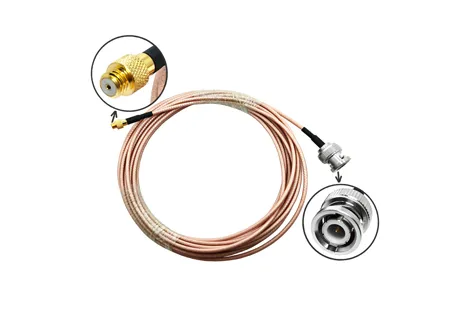
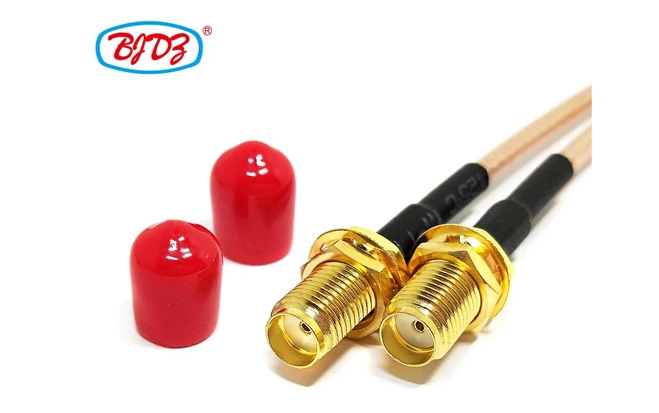
A coaxial cable is a type of cable that has two concentric conductors, with the conductor and the shielding layer sharing the same axis. The most common coaxial cable consists of a copper wire conductor separated by insulating material, with another layer of annular conductor and its insulator outside the inner insulation, and the entire cable is encased in a sheath made of PVC or Teflon material.
Coaxial cables can be divided into two basic types: baseband coaxial cable and broadband coaxial cable. Currently, baseband is the commonly used cable, with its shielding wire made of copper mesh, having a characteristic impedance of 50 ohms (e.g., RG-8, RG-58). Broadband coaxial cables typically have a shielding layer made of stamped aluminum, with a characteristic impedance of 75 ohms (e.g., RG-59).
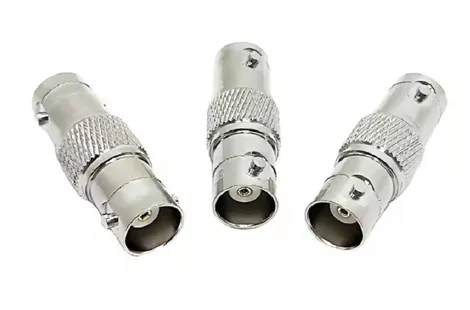
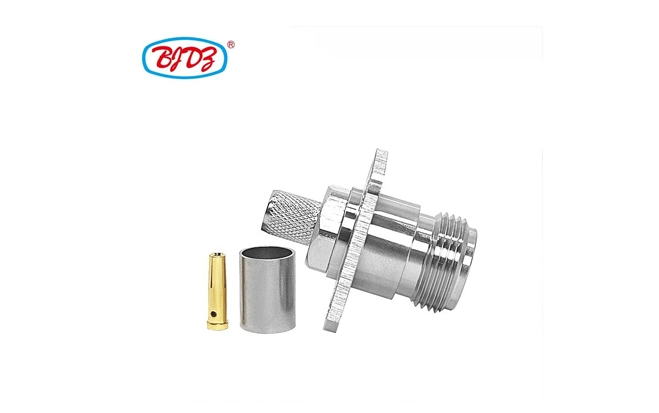
Coaxial cables can also be classified by their diameter into thick coaxial cables and thin coaxial cables. Thick cables are suitable for larger local networks, offering longer standard distances and higher reliability. Since installation does not require cutting the cable, the network position of computers can be flexibly adjusted as needed. However, thick cable networks must install transceiver cables, making installation difficult and overall cost high. Conversely, thin cables are easier to install and cheaper, but the installation process requires cutting the cable and attaching basic network connectors (BNC) to both ends, which are then connected to T-connectors. This can lead to potential issues when there are many connectors, which is a common fault in currently operating Ethernet networks.
Both thick and thin cables use a bus topology, where multiple machines are connected to a single cable. This topology is suitable for environments with dense machines, but a fault at one point can affect all machines on the cable. Diagnosing and repairing faults can be troublesome, so coaxial cables are gradually being replaced by unshielded twisted pair or fiber optic cables.
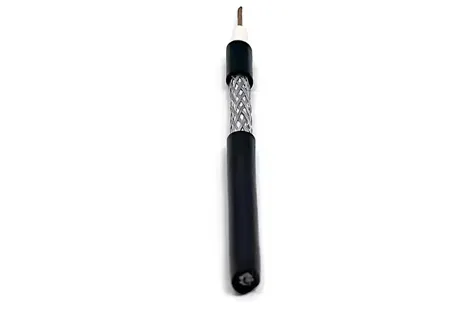
A coaxial cable consists of four layers from the inside out: a central copper wire (either a single solid wire or multiple stranded wires), a plastic insulator, a mesh conductive layer, and an outer sheath. The central copper wire and the mesh conductive layer form the current loop. The name “coaxial” comes from the fact that the central copper wire and the mesh conductive layer share the same axis.
Coaxial cables conduct alternating current (AC) rather than direct current (DC), meaning the direction of the current reverses several times per second.
If a regular wire is used to transmit high-frequency current, it would act like an antenna emitting radio waves, which would result in signal power loss and reduced signal strength at the receiver. The design of coaxial cables addresses this issue. The radio waves emitted by the central wire are isolated by the mesh conductive layer, which can control the emitted radio waves by grounding.
However, coaxial cables have a problem: if a section of the cable is significantly compressed or twisted, the distance between the central wire and the mesh conductive layer will not remain constant, causing internal radio waves to be reflected back to the signal source. This effect reduces the receivable signal power.
To overcome this issue, a layer of plastic insulator is added between the central wire and the mesh conductive layer to ensure a constant distance between them. This also makes the cable relatively stiff and not easy to bend.
Coaxial cables have multiple advantages, including high bandwidth and low signal loss, making them suitable for long-distance transmission. Their shielding design effectively reduces electromagnetic interference, ensuring signal stability. Additionally, coaxial cables are robust and durable, suitable for use in various environments. Installation and maintenance are relatively simple and cost-effective, making them widely used in television broadcasting, internet, and communication systems.
This is the first one.
 English